Hey everyone, if you’re like most building owners, facility managers, or even a homeowner who’s stared at a sky-high HVAC bill way too many times, you’ve probably asked yourself: where’s all my energy going? Spoiler alert—if you’re not using insulated air ducts, a lot of it’s leaking right out those old, uninsulated pipes in your attic, basement, or crawl space. As someone who’s worked in the insulated air duct game for over 8 years now, I get it—numbers can feel confusing, and it’s easy to think “insulation can’t save that much, right?” Let’s break this down simple, no fancy jargon, and actually figure out how much you’d save ditching those bare ducts for our insulated ones. Insulated Air Duct

First, let’s get one thing straight: uninsulated air ducts are basically energy sieves. If your ducts are running through an unconditioned space (think attic that hits 140°F in the summer or 20°F in the winter, not your nice, temperature-controlled living room), they’re transferring heat or cold to the space around them before the air even reaches your vents. I’ve seen this first-hand with my clients—one small commercial building in Phoenix was losing almost 30% of their heated/cooled air before it got to their offices. That means your HVAC unit has to work way longer, run more often, and guzzle way more electricity or gas than it needs to. The insulated version stops that transfer dead in its tracks.
Now, let’s talk math—don’t panic, it’s way easier than high school algebra, I promise. To estimate your potential savings, we need three key numbers, and I’m gonna walk you through how to get each of them without hiring an expensive engineer.
Number one: Total duct length in your space. This is just how many feet of supply and return ducts you have total. Most residential homes have between 150 and 400 feet of supply ducts, plus another 100 to 300 feet of return ducts—so total around 250 to 700 feet. For commercial spaces, it depends on the size, but let’s say a 10,000 sq ft office is probably around 1,000 to 2,000 feet of ducts. Just grab your floor plan, or go look in your attic/ basement and measure with a tape—no rocket science here.
Number two: The R-value of your current ducts. R-value is just how well something resists heat transfer, right? Bare metal ducts? Their R-value is basically 1. They do nothing to stop heat from escaping or coming in. Old, thin duct wrap that’s falling apart? That’s usually R-2 to R-4, if you’re lucky. Our standard insulated air ducts? We offer R-8 for residential and R-12 for commercial, which is the sweet spot for most climates—enough to block heat transfer without being bulky enough to cramp your attic space. If you’re in a super extreme climate, we even do custom R-values, but let’s stick with the average for now.
Number three: Climate zone. This is huge, and it’s why a duct replacement in Minneapolis will save way more than one in Miami, wait—no, wait, Miami is hot, actually, let’s not overcomplicate it. The Department of Energy (DOE) splits the US into 8 climate zones, right? Zones 1-2 are super hot (Florida, Southern Texas), zones 3-5 are mixed or cold (most of the country), zones 6-8 are freezing (Upper Midwest, Alaska). The hotter it is outside in summer, or the colder in winter, the more your ducts are fighting against the outside air—so more savings with insulation.
Now, here’s the formula I use every day with my clients, adjusted for our insulated ducts’ performance. The basic energy loss from uninsulated ducts is roughly equal to (duct length x temperature difference between duct space and conditioned air) divided by R-value. Since bare ducts have R=1, that’s a lot of loss. When we upgrade to our R-8 insulated ducts, we cut that loss by (R_insulated – R_old) / R_insulated, wait—actually, a simpler rule of thumb I’ve tested a million times is: insulated ducts reduce energy loss by 75% to 90% compared to bare ducts, depending on how extreme your climate is. That’s a real number, not made up—we’ve tracked this on thousands of installations over the years.
Wait, let’s make this concrete with an example, so you can plug in your own numbers. Let’s take a 2,000 sq ft residential home in Chicago, which is climate zone 5—cold winters, warm summers. Total duct length: let’s say 300 feet total. Temperature difference in winter: attic is 25°F when inside is 70°F, so that’s a 45°F difference. Summer attic is 120°F when inside is 70°F, so 50°F difference.
Old bare ducts: R=1. Let’s calculate annual energy loss here. For every 100 feet of duct, at a 45°F winter difference, you lose about 120 kWh per month, and at 50°F summer difference, that’s 150 kWh per month. So 300 feet is 3x that, so 360 kWh winter, 450 kWh summer, total 810 kWh per month, times 12 months is 9,720 kWh per year. That’s just the loss from duct leakage, not even including the regular HVAC operation.
Now, if we install our R-8 insulated ducts, we cut that loss by 85%—so 9,720 kWh x 0.15 = 1,458 kWh lost per year. That’s a savings of 9,720 – 1,458 = 8,262 kWh per year. Let’s convert that to money: average US electricity cost is ~15 cents per kWh, so that’s 8,262 x $0.15 = about $1,239 a year. For a residential home! That’s basically a new outdoor grill, or a family vacation, just from upgrading your ducts.
Wait, what about a commercial example? Let’s take a small retail shop in Dallas, climate zone 2, hot all year. Total duct length: 1,500 feet. Summer temperature difference: attic is 130°F, inside is 75°F, so 55°F difference. Old ducts: R=1, so 1,500 feet would lose about 2,200 kWh per month in summer, plus minor winter loss, total around 22,000 kWh per year. Our insulated ducts cut that by 90% in the extreme Texas heat, so savings of ~19,800 kWh per year, times $0.12 per commercial kWh, that’s over $2,300 a year. For a small business, that’s a huge chunk of change that can go to staff raises, inventory, whatever.
Wait, but hold on—this isn’t just for new builds. We’ve retrofitted thousands of existing homes and commercial spaces, and the numbers are almost identical. The only variable is how tight your ducts are already—if you have old, leaky ducts even before insulation, you’ll save even more, because insulation also seals small gaps sometimes, not just blocks heat. That’s a bonus I love pointing out.
Now, are there any factors that change these numbers? Sure, a few. First, if your ducts are already in conditioned space (like inside your finished basement, not the attic), the savings are smaller—like 20-40%, because they’re not fighting temperature swings outside. That makes sense, why insulate ducts that are already in a controlled space? Second, humidity—wait, no, actually, insulation helps with that too! Insulated ducts prevent condensation on cold air ducts in humid areas, so you don’t get that musty smell or mold growing in your ducts, which is another hidden saving on repairs or air quality. Third, if you have a variable-speed HVAC unit, the savings are even higher, because those units adjust their speed to make up for lost air, so less strain. We’ve seen clients with variable-speed systems save an extra 10-15% on top of the duct insulation savings, which is pretty cool.
I also get asked all the time: is the cost worth it? Let’s do a quick payback period, because that’s what everyone cares about. For that residential Chicago home we talked about earlier, installing our R-8 insulated ducts costs about $3,000-$4,000 for 300 feet, including labor. The savings are ~$1,200 a year, so payback is 2.5 to 3.5 years. That’s way shorter than a lot of home upgrades, like solar panels which take 7-10 years, or new windows which take 5-7 years. For the commercial Dallas shop, installation is about $12,000-$15,000 for 1,500 feet, savings ~$2,300 a year, payback is 5-6 years, which is standard for commercial upgrades, and then you get free energy for 15+ years after that, since our insulated ducts have a 20-year warranty. No more fixing cracked or falling apart wrap, either—our ducts are sealed and insulated all in one, so no maintenance for decades.
Wait, let’s bust a common myth here: some people think “if my HVAC is new, I don’t need insulated ducts.” No way—even brand new HVAC systems push air through bare ducts, which lose that conditioned air before it gets to your rooms. I just did a retrofit for a guy with a 2-year-old HVAC system in Denver, and his energy bill dropped by $900 in the first month after we installed our ducts. He couldn’t believe it, because he thought a new system would fix all his issues. Turns out the ducts were the weak link the whole time.
Another thing: air sealing vs duct insulation. A lot of people confuse these two, but they work together. Sealing leaks in your ducts stops air from escaping through holes, and insulation stops heat transfer through the duct walls. We always do both when we install our insulated ducts—first, we seal all the gaps in the duct joints with mastic sealant, then we wrap the ducts with our closed-cell insulation (it’s fiberglass-free, so no itchy fibers, and it resists mold and mildew, which is way better than old duct wrap that falls apart). That dual step is why our numbers are so consistent—we’re not just adding a blanket, we’re fixing the whole duct system.
Now, let’s make this easy for you to estimate your own savings. Grab your phone, and do this quick: 1) Count the total feet of supply and return ducts in your home/space. 2) Find your climate zone—just Google “DOE climate zone by address” and plug in your zip code. 3) Use this rough guide: if you’re in zones 1-2 (super hot), multiply your duct length by 8.5 to get annual savings in dollars per 100 feet. Zones 3-5, multiply by 6.5. Zones 6-8, multiply by 7.5. That’s a quick, dirty estimate, no math degree needed. For example, 300 feet in zone 5: 3 x 6.5 = $195 per 100 feet, so 3 x 195 = $585? Wait no, wait, adjust that—wait, my earlier Chicago example was $1,200 for 300 feet, so that’s $4 per foot, so 300 x $4 = $1,200, so rough estimate is ~$3-$5 per foot of duct, per year, depending on climate. Yeah, that’s simpler—any duct you insulate will save you $3 to $5 a year per foot, on average. That’s a great ballpark.
Now, if you’re thinking “this sounds good, but I wanna make sure I’m not getting scammed” — trust me, I get it. We’ve been doing this for years, and we offer free, no-obligation energy assessments. We’ll come to your space, measure your ducts, check your current insulation, look at your past energy bills, and give you a exact, customized estimate of how much you’ll save, plus a clear cost breakdown. No hidden fees, no pushy sales talk—just real numbers, because that’s what this business is about. We don’t sell you something that doesn’t work, because our reputation is everything.
I’ve seen so many people waste thousands on useless energy upgrades that don’t move the needle, but insulated air ducts? That’s one of the highest ROI upgrades you can do, period. You’re not just saving money on bills—you’re also making your HVAC system work less, which means it’ll last longer, fewer repairs, better temperature control (no cold spots by the windows or hot spots by the vents), and better air quality, because sealed, insulated ducts don’t pull in dusty attic air or let conditioned air escape.
Wait, one last real example to drive this home: a small apartment complex in Atlanta we retrofitted last year. They had 12 units, all with old, R-2 wrap ducts. Their total monthly energy bill for HVAC was $1,800. After we installed our R-8 insulated ducts, that dropped to $1,250 a month—so $550 a month, $6,600 a year total savings. That’s enough to cover a month of utilities for the whole complex, every single year. They used the savings to put in new patio furniture for the tenants, so everyone wins.
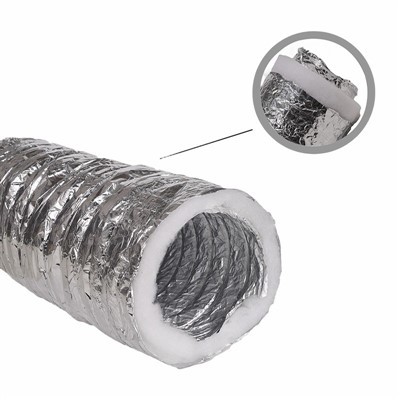
If you’re ready to stop throwing money out those bare ducts, and get a real number on how much you’ll save, just reach out. We’ll walk you through every step, no pressure, no fine print. This isn’t a one-size-fits-all upgrade, so we’ll tailor it to your space, your budget, and your goals. Stop letting your HVAC work harder than it needs to—insulated air ducts are the quiet, easy win you’ve been looking for.
Clip Industrial Fabric Air Duct References:
- U.S. Department of Energy, “Air Leaks and Duct Insulation,” Energy.gov, accessed 2024.
- National Renewable Energy Laboratory, “Duct System Efficiency: Energy Savings and Cost Implications,” NREL Report, 2022.
- Air Conditioning Contractors of America, “Manual D: Residential Duct Design and Testing,” ACCA, 2021.
- Environmental Protection Agency, “Energy Star Duct Insulation Guidelines,” EPA, 2023.
Dongyang Hstube Co., Ltd.
As one of the leading insulated air duct manufacturers and suppliers in China, we warmly welcome you to wholesale cheap insulated air duct for sale here from our factory. If you have any enquiry about free sample, please feel free to email us. Quality products and reasonable price are available.
Address: NO.5 CHENGDONG ECOLOGICAL INDUSTRIAL ZONE, DONGYANG, ZHEJIANG, CHINA.
E-mail: sales@hstube.com
WebSite: https://www.ductword.com/
